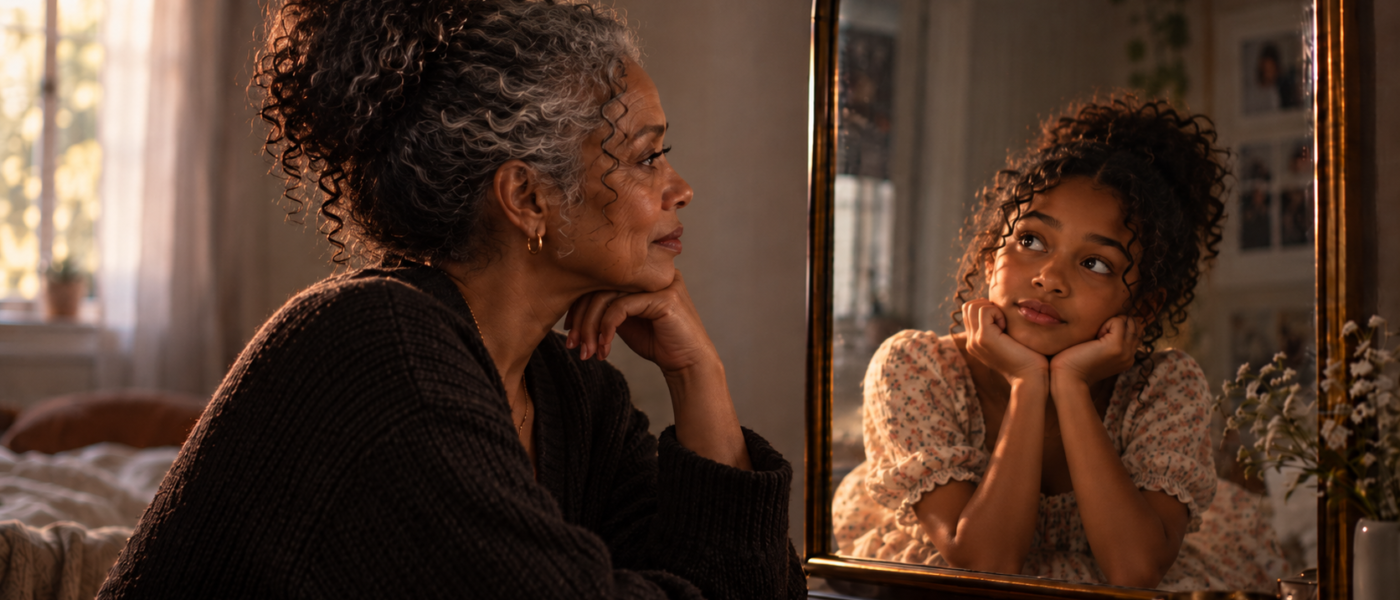
Growing up, I had so much male presence in my life. A million brothers, uncles, male cousins and family friends. Everywhere I turned, man, man, man. So naturally, I started acting like a guy, despite my mother’s best efforts.
I would climb trees, play football, fight, rough around and all that. I even used to sag my skirt in primary school, yes, my skirt. At some point, my mum got tired and had this brilliant idea to ship me off to an all-girls boarding school, hoping loads of girls around would help. LMAO. I went and started teaching people’s children how to be manly.
In that school, we were required to keep our hair low-cut, and I would shave mine ridiculously low, carve the hairline and put a side part in it. The school would use me as an example of the model student, and I felt, well, at least someone saw the vision. It got to the point where my mum basically made up her mind that she did not have a girl child.
Flash forward to university, and I slowly started evaluating things differently. I reduced the gra gra attitude. I started wearing skirts and dresses without anybody having to fight me on it. I learnt how to walk in heels. I still like my baggy clothes, but over time I found a balance that works for me and fits who I want to be.
I could easily have stayed the way I was and constantly complained that I acted so masculine because of my upbringing. I grew up around so many boys, so obviously that was just who I was. It was in my DNA. There was nothing I could do about it. But that was not the case. I decided what I wanted, and gradually I started acting on that rather than on what had shaped me.
There comes a point where your upbringing can no longer be the final explanation for who you are. It can explain you, absolutely. The way you communicate, respond to anger, handle conflict, what you think love should look like, how you approach money, relationships, vulnerability, even the way you see yourself can often be traced back to what you saw growing up. As children, we absorb things without knowing we are learning them. If nobody apologised in your house, apologising might feel foreign. If every disagreement involved shouting, you may grow up believing that is simply what people do when they are angry. If problems were always swept under the rug, avoidance might become your default.
And recognising where something came from does not make changing it easy. Knowing better does not automatically mean doing better comes naturally.
I can see that in myself in ways that are much harder to change than how I dress. Growing up, crying was not really encouraged in my house, especially by my dad. He hates crying. To him, it is either a sign of weakness or a way of manipulating the person you are crying in front of. Somewhere along the line, I absorbed that. I learnt to hold things in, get myself together and keep moving.
I am still trying to unlearn it. Crying does not make me weak, and expressing hurt does not mean I am manipulating anybody. Sometimes something simply hurts, and when life is lifing, the only thing you can do is cry. But my instinct is still to shove it down and pretend I am fine. Understanding that does not suddenly make it easy.
At the same time, my mum raised us to speak up. If something is wrong, say something. If someone does something to you that you do not like, do not sit quietly and pretend it is “all good”. I am glad I was taught to have a voice and use it. What I have had to learn, though, is that having a voice does not mean using it every single time something enters your head.
There is a time, a place and a way to say things. Sometimes you need to speak immediately. Sometimes you need to calm down first. Sometimes you need more information. Sometimes what you want to say may be true but unnecessary. And sometimes, quite frankly, you need to mind your business. That does not mean my mum’s lesson was wrong. It means I had to refine it.
That is another part of growing up. Not everything you inherit needs to be thrown away. Some things need to be unlearned, some are worth keeping, and some good lessons simply need more wisdom added as you get older.
Some habits are harder to shift because they have been reinforced for ten, twenty or thirty years. Some were once survival mechanisms that helped you cope with whatever environment you were in. That is why growth can mean therapy, boundaries, distance from certain environments, or catching yourself halfway through a bad reaction, apologising and trying again. Sometimes you think you have dealt with something, only for life to trigger it again. That does not mean you have failed. It means growth is not neat.
Viola Davis has spoken openly about this. She grew up in extreme poverty, around domestic violence and alcoholism, and has talked about carrying the effects of that childhood long after her circumstances changed. What interests me is not that she became successful. It is that success did not erase what happened to her. She still had to confront the little girl she had been and the ways that little girl kept showing up in the adult she became. Her upbringing explains parts of who she is, but it did not get to dictate the rest of her life.
We sometimes talk about breaking cycles as though it is one grand decision. But it is far less glamorous than that. Sometimes it is apologising when nobody ever apologised to you. Sometimes it is learning to express affection when affection was uncomfortable in your home. Sometimes it is allowing yourself to feel what you were taught to suppress, or choosing peace when chaos feels more familiar. Sometimes it is simply making the better choice again and again until it becomes your natural response.
And I think two things can be true at the same time: it can be incredibly unfair that you have to fix something you did not break, and it can still be your responsibility to fix it.
You are not responsible for what happened to you as a child, or for what adults failed to teach you. But there comes a point where you become responsible for what you do with it.
There is a difference between saying, “I struggle with communication because nobody communicated properly in my home, and I am working on it,” and saying, “I do not communicate because that is how I was raised, so deal with it.” One acknowledges the cause. The other uses the cause as permission.
At some point, you cannot keep hurting people and handing them your childhood as your apology. You cannot keep screaming at people because that is what your father did. You cannot refuse to apologise because nobody apologised to you. Your reason may be valid, but the consequences are still yours.
As you grow older, you stop being only the person who was shaped by other people. You start shaping people too. You become someone’s partner, friend, colleague, maybe one day someone’s parent, and people who had nothing to do with your childhood end up living with the consequences. You may not have created the wound, but you are still responsible for what you do while wounded.
None of this means rejecting everything about your upbringing. Maybe your family taught you resilience, generosity, humour, faith, ambition or an incredible work ethic. Keep those. Maybe they taught you to speak up. Keep that too, but add discernment. Maybe they taught you to be strong. Keep the resilience, but learn that strength does not require suppressing every emotion. The point is not to be ashamed of where you came from. It is to inspect what you were given and decide what stays, what goes and what needs to change shape.
There are parts of me that came directly from how I grew up. Some I love. Some I have changed. Some I am still working on, because growing up is not something you finish at twenty-one, thirty or forty. Sometimes you realise that something you have been calling your personality for years is actually just a habit you learnt as a child. When that happens, there are two questions worth asking: where did this come from, and now that I know, what am I going to do about it?
Because “this is how I was raised” can explain a lot. It can explain why something is harder for you, why you need more time, more grace, more support or professional help.
But eventually, it cannot be the final sentence.
You did not choose everything that shaped you, but at some point, you have to decide what continues shaping you. And maybe that is what growing up really is.
STAY SHINING