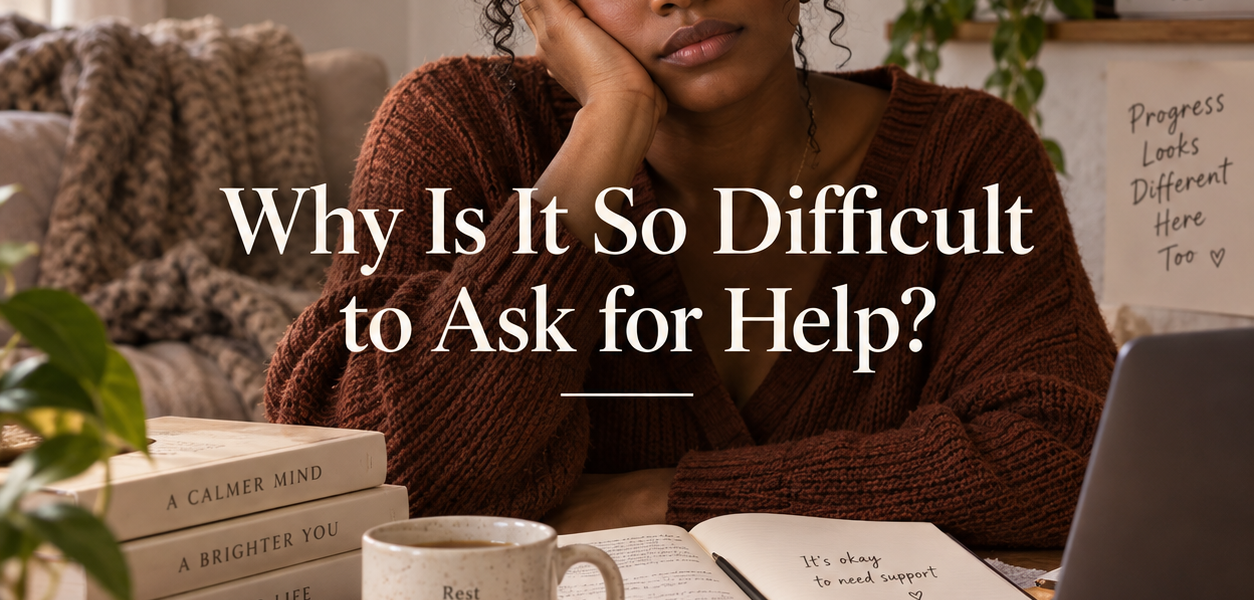
I have always wondered why asking for help is such a big deal for me. I know I need help. I know I can ask for help. I know there are people I can ask. But no. With coconut head, I will still want to get it done myself, almost like someone told me there is an award for the person who suffers the most. It is so bad that someone can literally look at me, buried underneath a ton of things, and ask, “Do you need help?” and I will still say, “Nah, it’s okay,” when in reality, it is indeed not okay o.
I could be stressed, overwhelmed, running out of time, and very obviously in need of another pair of hands, yet something in me insists I can manage. Somehow. Even if “managing” means making life significantly harder for myself. And I have been trying to understand why, because I don’t think it is always as simple as pride, although I’m sure pride is somewhere inside the soup. I don’t necessarily think needing help makes someone weak. I don’t look at other people who ask for help and think, Wow, how incapable of you. If anything, when someone asks me for help, I usually think about whether I can help them.
So why does the logic disappear when it is my turn? Part of it, I have realised, is that asking for help means I now have to explain exactly what I need help with. And sometimes, I cannot. Sometimes all I know is that I am overwhelmed. There are too many things happening at once; my brain feels full, and I would like somebody to remove approximately four things from my plate. But if you ask me, “Okay, what do you want me to do?” suddenly I have another assignment.
Now I have to think about the problem, break it down, decide what can be delegated, explain it properly, answer questions and possibly supervise the person helping me. At that point, something in my head goes, Abeg, I go kuku do my thing by myself. Because why is asking for help beginning to look like more work?
Other times, I know exactly what I need, but I don’t know how to communicate it in a way that makes sense to someone else. I know what the finished thing is supposed to look like in my head. I know the particular way I would approach it. I know the tiny details that matter to me. But translating all of that into instructions can feel more exhausting than simply doing it myself. And yes, I am aware that this sounds suspiciously like a control problem.
Then there is the other fear: what if I ask for help and the person does it completely differently from how I wanted it done? Now we have entered dangerous territory because they have helped me. They have spent their time and energy doing something I asked them to do. I should be grateful, and I am grateful. But what happens when I also hate what they have done?
How do you say, “Thank you so much for helping me, but actually, this is not what I meant,” without sounding ungrateful? How many corrections are you allowed to give before it starts looking like you should have simply done it yourself? At what point does “Can you help me?” become an unpaid internship where I am hovering over your shoulder saying, “No, not like that”? Sometimes avoiding that entire situation feels easier. I will just do it myself, and if it turns out badly, at least I can blame myself in peace.
I think that is one part of asking for help that we do not always acknowledge. Help requires some amount of surrender. You have to accept that another person might not do something exactly the way you would do it. They might take a different route, prioritise different things, misunderstand you or make a decision you would never have made. If you are someone who likes things a certain way, accepting help means giving up a little bit of control.
Maybe that is why “I’ll just do it myself” can feel so comforting. It is exhausting, yes, but at least I know what is happening. There is no need to explain, no need to wait, no need to depend on another person and no possibility of being disappointed because you already know exactly who you are dealing with: yourself. Except, of course, there is one small problem with this wonderful system. There is only one of you, and eventually, one person cannot carry everything.
I think another reason I struggle with asking for help is the fear that I am asking for too much. This one is strange because “too much” is such an arbitrary measurement. Too much according to whom? Sometimes nobody has actually told me I am asking for too much. I have simply decided in advance that my request is unreasonable. Someone could have the time, the willingness and the capacity to help me, but I would have already created an entire conversation in my head where they are secretly irritated.
So instead of allowing them to decide whether they can help, I decide for them. They are probably busy. I don’t want to disturb them. It’s not that serious. I can sort it out. Meanwhile, it is serious. I cannot sort it out. And I am, once again, unnecessarily suffering.
There is something funny about how often those of us who struggle to ask for help believe we are simply being considerate. We tell ourselves we do not want to inconvenience anybody, that we do not want to be a burden and that we do not want anyone rearranging their life because of us. All very noble. But sometimes I wonder if what we are calling consideration is actually fear, because asking someone for help allows them to say no.
Maybe I would rather never ask than hear that. There is safety in never needing anything from anybody. If I do not ask, you cannot refuse. If I do not depend on you, you cannot disappoint me. If I do not tell you I am struggling, I never have to find out whether you would actually show up for me. That kind of independence can look like strength from the outside, and sometimes it is strength. Sometimes, though, it is armour.
The annoying thing is that I know how unreasonable some of this is because I do not apply the same rules to other people. If someone I care about asked me for help, I would not immediately think they were a burden. If I could help, I would. If I couldn’t, I would say so. I would much rather someone tell me they are drowning than sit quietly beside me pretending they are fine because they do not want to inconvenience me. So why do I assume that my own needs will automatically irritate everybody else?
There is a certain satisfaction in being the person who can handle things. I like being resourceful. I like knowing that if something goes wrong, I will probably find a solution. I like being able to depend on myself, and I do not want to lose that. But I am starting to realise that there is a difference between being capable and insisting on doing everything alone. Self-sufficiency is useful. Self-inflicted suffering is another thing entirely.
Because sometimes there genuinely is no trophy. Nobody is standing at the finish line waiting to announce that I independently completed seventeen tasks, nearly lost my mind, slept four hours and refused three perfectly good offers of assistance. There is no medal. Nobody even knew we were competing.
Maybe the bigger question is not simply, Why is it so difficult to ask for help? Maybe it is also, What do I think asking for help says about me? That I am incapable? That I am demanding? That I am a burden? That I have lost control? Because if I can figure out what I am actually afraid of, perhaps asking becomes a little easier.
I am still very much a work in progress on this. I will probably still say “It’s okay” when it is, in fact, not okay. I will probably still catch myself halfway through an unnecessarily difficult task and realise there was somebody I could have asked two hours ago. I will probably still accept help, watch someone do something differently from how I would have done it and have to physically restrain myself from taking over. Baby steps.
But I am learning that asking does not automatically make me a burden. People are allowed to say no. People are allowed to have boundaries. People are also allowed to say yes. And perhaps I need to stop rejecting myself on their behalf before I have even given them the chance.
So the next time somebody sees me visibly fighting for my life underneath an entirely avoidable mountain of things and asks, “Do you need help?” maybe I will resist the ancestral urge to say, “Nah, it’s okay.” Because sometimes, it really is not okay, and there is no award for suffering the most.
STAY SHINING